Persian Gulf security cannot be bought: King’s College expert
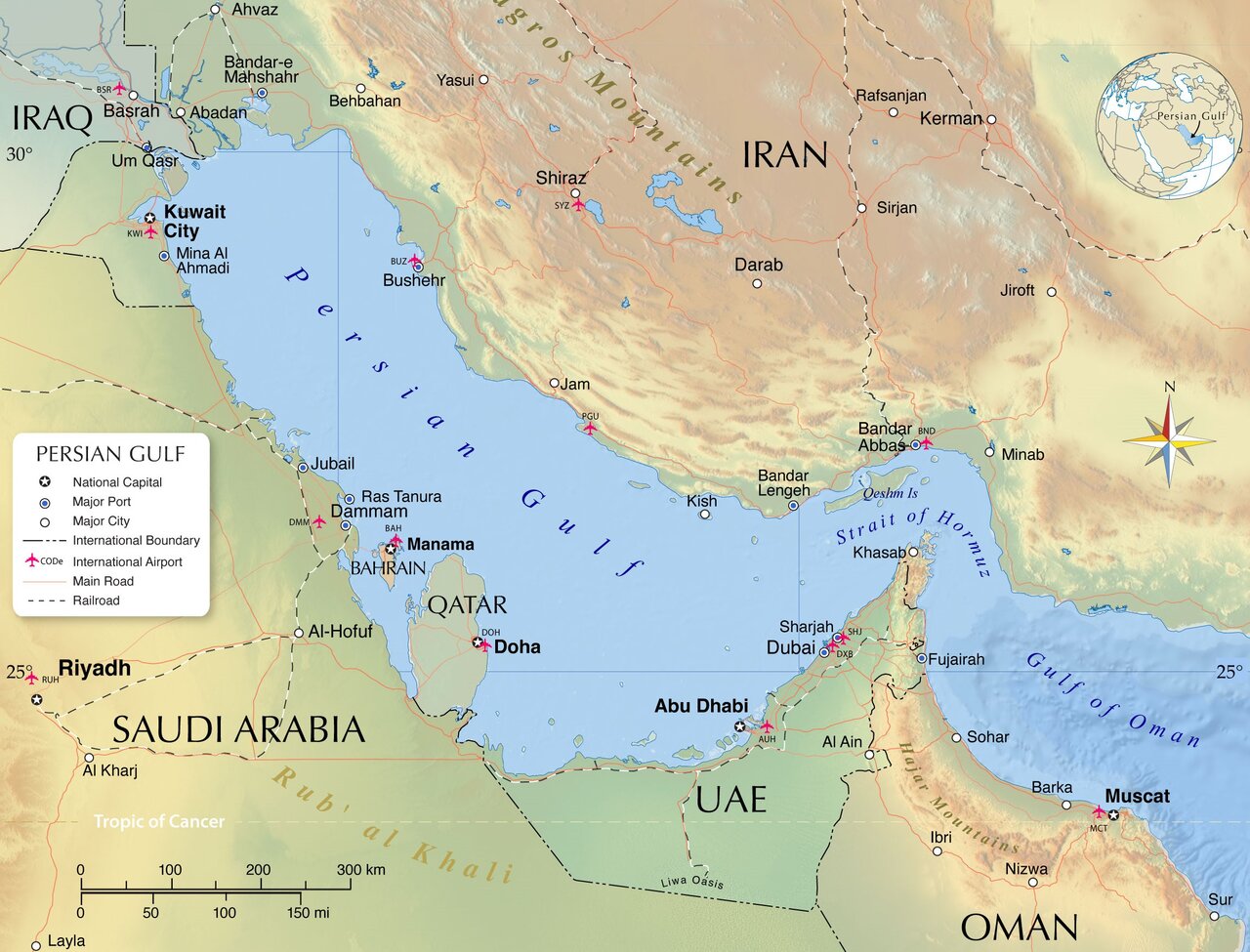
TEHRAN - David B. Roberts, a reader in Middle East Security Studies at King’s College London, suggests that Arab states on the southern shores of the Persian Gulf must build their own security, rather than “buy” it.
Roberts’ suggestion comes as Iran targeted U.S. military bases in the UAE, Kuwait, Saudi Arabia, and Qatar, the very installations used by the U.S. to launch strikes against Iran during the joint U.S.-Israeli war of aggression initiated in late February.
Writing in Foreign Affairs on May 18, Roberts believes that these regional Arab states must deal with Iran themselves rather than wait for Washington to do it for them.
Roberts, also the author of “Security Politics of the Gulf Monarchies,” says Iran is strategically flexible and its foreign policy has been shaped by incentives and deterrents.
An excerpt of the article titled “A New Order for the Gulf” is as follows:
The U.S.-Israeli war with Iran has put the Persian Gulf Arab states in an impossible position. The American forces they host have become the main reason their hotels and energy infrastructure are under jeopardy. Tehran retains the capacity to strike the Persian Gulf Arab neighbors, and its grip on the Strait of Hormuz is undiminished. U.S. President Donald Trump is as likely to take any deal he can call a victory as he is to escalate; either way, the Persian Gulf Arab states lose. The leaders of these countries must stop waiting for Washington to deliver an outcome that serves them.
The way out requires abandoning the assumption that has governed security for a century: that security is a commodity to be brokered rather than a capability to be built. This requires the Persian Gulf Arab states to deal with Iran themselves rather than wait for Washington to do it for them. A settlement between the Arab monarchies and Iran should take the form of a treaty in which a phased U.S. military withdrawal from its Gulf bases serves as the cornerstone of a comprehensive regional bargain. The U.S. withdrawal would be a calculated move. Iran has wanted the United States to leave the Persian Gulf for decades. To achieve this, along with phased relief from international sanctions, Tehran moves toward diplomatic normalization with its neighbors. Such a systemic reset of intra-Persian Gulf relations would mark the start of a new regional order.
For decades, the monarchies have outsourced their security to international partners, and their forces reflect that arrangement.
The illusion of protection
External patrons often betray interests of the Arab on the southern shores of the Persian Gulf. The United Kingdom ceded two-thirds of Kuwaiti territory in 1922, abandoned its allies in Yemen in the 1960s, and when withdrawing British forces from the Persian Gulf in 1971 (where they had been in one form or another for around 150 years) acquiesced to Iran’s ownership of three islands in the Persian Gulf. Washington’s record is little better. It liberated Kuwait from Iraqi occupation in 1991—but leaders of these countries give it too much weight. The United States intervened because doing so served American interests at a moment of unipolarity. The episode says little about what Washington will do when the interests of these countries and America next diverge.
The failure of outside protection is just one aspect of a deeper problem. The Persian Gulf Arab states often suffer—much as Europe has—from a lack of seriousness in military affairs, luxuriating instead in the illusion that the United States will protect them indefinitely. No strategic rationale explains why these states so dependent on maritime exports.
Détente: now, or later
Some officials in these Arab states are pushing for the United States to “finish the job” against Iran—a sentiment captured in the demand, voiced privately across their capitals, that Washington not stop until Iran can no longer hold the Strait of Hormuz at risk or strike infrastructure with impunity. But the Islamic Republic survived an existential eight-year war with Iraq that wrecked its economy and killed hundreds of thousands of Iranians, decades of sanctions, and an Israeli campaign of assassinations of senior figures. Now, months into one of the most sustained bombing campaigns the region has ever seen, Iran still stands and able to launch drones and missiles at its enemies. Betting that it will collapse through pressure alone is a wager the historical record does not support.
All wars end. The only question is whether a settlement comes after months or years. Bitter rivals eventually seek accommodation, as Iran and the Persian Gulf Arab states have in the past. Before the current war becomes catastrophic, Iran and these monarchies should pursue a treaty in which the United States withdraws from its bases in the region. Such a treaty would lay the foundation for a new regional order, one in which these sheikhdoms shape the terms of their security rather than relying on patrons whose interests will not always align with their own.
A phased U.S. withdrawal over five years would remove a structural cause of insecurity in the region. This would entail the departure of U.S. forces from the major installations in the region—Al Udeid in Qatar, the Fifth Fleet’s headquarters in Bahrain, Al Dhafra in the United Arab Emirates, Ali Al Salem and Camp Arifjan in Kuwait, and Prince Sultan in Saudi Arabia. Iranian strategic doctrine sees the American regional military presence as a threat and the primary target of its deterrence strategy. An Iran no longer facing threats from the United States and Israel would be less driven to forever expand its military capabilities. In exchange for a U.S. withdrawal, a prize that has never before been on offer, Tehran is likely prepared to concede more than it has under any previous agreement.
The nuclear question is central. Any plausible settlement would see Iran restore cooperation with the International Atomic Energy Agency on terms more intrusive than those of the 2015 Joint Comprehensive Plan of Action. The Persian Gulf Arab states’ own nuclear programs could provide the basis for a framework of mutual inspections, transparency, and trust-building. That, in turn, could constrain Israel’s unilateral operations against Iran.
The objective is to transform the Persian Gulf from a contested battlefield into an integrated economic zone in which the costs of conflict would be borne by all parties, Iran included.
Some may object that Iran will not honor such a compact. A more pragmatic reading of Iran casts it as a rational state actor pursuing legible strategic objectives: the removal of U.S. military from its neighborhood, recognition of its regional standing, the survival of the Tehran regime. On that view, its behavior is sensitive to inducement.
Iran is strategically flexible; its foreign policy has been shaped by incentives and deterrents. Iran has often been practical, enjoying eras of regional détente in the 1990s and 2000s, adhering to the Joint Comprehensive Plan of Action for over a year after Washington’s 2018 withdrawal and then continuing to comply in part, and restoring relations with Saudi Arabia in 2023.
Leave a Comment